Airport transfers from Bradford to Manchester, Leeds Bradford, or Heathrow look like a commodity service. The price comparison websites, ride-share apps, and aggregator platforms have made it feel that way. A vehicle, a driver, a fixed price. Pick the cheapest one.
The problem is that airport transfers are not really a transport service. They are a logistics service with a fixed deadline, and the deadline is the moment the airline closes the gate. A booking that works 95% of the time but fails 5% of the time is not a 95% success. It is a 5% chance of missing a flight, losing the hotel, and rebooking everything at short notice.
The cheapest airport transfer quote almost always excludes something. Sometimes it is luggage capacity. Sometimes it is waiting time on the return. Sometimes it is the additional fee for picking up after midnight or before 6am. The price on the quote is real. The total price after the trip is often higher.
The bigger issue is what the cheap price implies about the operation. Margins on airport transfers are tight. An operator quoting significantly below the market is doing one of three things: running with older vehicles, using less experienced drivers, or accepting the booking knowing that they will subcontract it to whichever local operator is available on the day.
Subcontracting is not in itself a problem. Subcontracting without telling the customer is. The vehicle that turns up may not be the vehicle that was advertised, the driver may not have been briefed on the flight times, and accountability becomes harder to trace if something goes wrong.
Any serious airport transfer operator tracks the flight. Specifically, they track the inbound flight on a return transfer so that if the flight is delayed by an hour, the driver arrives an hour later and does not charge waiting time.
A surprising number of operators do not do this. They book the slot based on the scheduled arrival time. If the flight is delayed, the driver either leaves, charges hourly waiting, or fails to be there when the passenger eventually exits the terminal.
The question to ask before booking is direct: do you track the inbound flight, and what is the included waiting time after the scheduled arrival? The answer should be specific. Forty-five minutes, sixty minutes, ninety minutes. Not “we will be flexible”.
The other end of the journey has a similar pattern. The cheapest quote often calculates pickup time based on the optimistic version of the route. Bradford to Manchester Airport in seventy-five minutes, for example, assuming no traffic.
This works on a Tuesday at 10am. It does not work on a Friday at 4pm when the M62 is congested, the M60 has a closure, and the journey is actually two hours. A booking with a tight pickup buffer is a booking that depends on traffic cooperating.
For a flight from Manchester or Leeds Bradford, a sensible buffer from Bradford is around three hours before the flight for international, two hours for domestic. The pickup should account for this. If an operator quotes a pickup time that gets you to the airport less than ninety minutes before an international flight, the buffer is too thin.
Cheap operators run cheap fleets. This is not always a problem, but it is a problem on the morning of a flight. A vehicle that breaks down on the M62 at 5am does not have a quick fix. The passenger is either rescued by a backup vehicle, if one exists, or left to call a taxi while watching the flight time disappear.
The question to ask is what the backup vehicle policy is and what the typical response time is. A serious operator with multiple vehicles in the fleet can usually dispatch a replacement within thirty to forty-five minutes from anywhere in West Yorkshire. An operator with a single vehicle, or one who subcontracts, may not be able to send anything at all.
Manchester Airport has three terminals. Leeds Bradford has a single terminal with a complicated drop-off layout. Heathrow has five. A driver who does airport transfers regularly knows which terminal each airline uses, knows where the short-stay drop-offs are, and knows the route from the motorway to the right terminal without checking signs.
A driver who does airport transfers occasionally takes the first exit, ends up in the wrong drop-off zone, and adds ten minutes to the journey. On a tight schedule, ten minutes is the difference between making and missing the gate.
This is not a question of skill. It is a question of frequency. Ask the operator how often they run airport transfers, and to which airports. If the answer is “we do them sometimes”, the driver may be doing your transfer for the second time that month.
A standard saloon car is advertised as carrying two large suitcases. In practice, with two large hard-shell cases and four pieces of carry-on, the boot is full and the back seat starts to take overflow. For a family of four going on a two-week holiday, a saloon is the wrong vehicle.
The right vehicle for a family with full luggage is usually an estate or an MPV. Ask the operator what specifically you are getting, not the category. “A saloon” can mean a Mercedes E-Class with a small boot or a Skoda Superb with a deep one. The difference matters when the cases come out at 5am.
Frequent business travellers from West Yorkshire tend to move away from apps and aggregators after a few bad experiences. The pattern is consistent. The first few transfers work fine. Then one goes wrong. The driver does not arrive. The replacement is forty minutes late. The flight is missed. A meeting is rescheduled. The cost of that missed meeting is significantly higher than the saving on the original transfer.
A dedicated airport transfer operator builds a relationship. They know your preferred pickup time before each flight. They have your usual terminal. They know whether you need a saloon for solo travel or an MPV when you are travelling with the team. The marginal cost over an aggregator is small. The marginal reliability is significant.
Three things, in this order.
A vehicle that arrives on time, every time, with a backup plan if something goes wrong.
A driver who knows the airport, the terminal, and the route, and who is not doing the transfer as an unfamiliar one-off.
Flight tracking on the return and a sensible pickup buffer on the outbound, both confirmed in writing.
If any of these is missing, the booking is exposed to the failure mode that costs more than the saving.
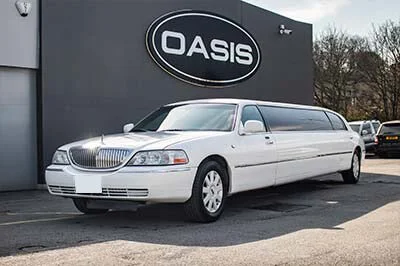
Oasis Limousines runs airport transfers from Bradford to Manchester, Leeds Bradford, Heathrow, and other UK airports. Inbound flights are tracked. Pickup times are calculated with traffic patterns in mind, not just the optimistic route. Backup vehicles are available within the local fleet. Drivers are familiar with the major UK airport terminals.
For a fixed quote, contact Oasis with the pickup postcode, the flight details, and the number of passengers and bags. The earlier the booking, the better the vehicle match.